
Seeing Light Like Rembrandt
Standing in front of a Rembrandt is strange. The canvas doesn't just hold paint. It holds air, shadow, something breathing.
Baroque painting in the 17th century was all about drama, motion, contrast. Rembrandt didn't just follow it. He bent it to his voice. Light isn't decoration, it tells. Shadow isn't emptiness, it's a companion, a secret.
You notice the glow on a cheek, the way light hits a book, a sword, even a simple piece of cloth. That's chiaroscuro. He learned it, and then made it entirely his own.
Chiaroscuro - More Than Light and Dark
Chiaroscuro is not just a way to make things look three-dimensional. In Rembrandt's hands, it becomes almost alive. Light and shadow don't simply exist on the canvas - they interact, converse, and pull the viewer in.
Take The Night Watch. At first glance, it's a large militia group portrait, crowded and chaotic. But the light is deliberate. It draws your eye first to the captain stepping forward, glove raised, then across to the figures surrounding him. A tiny girl carrying a flag is lit by a soft golden glow, almost mischievously, keeping the composition together. The shadows don't simply recede, they shape space and movement, creating a sense of air, depth, and energy.
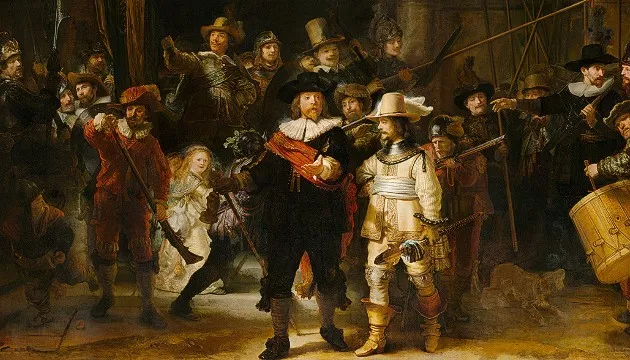 Militia Company of District II under the Command of Captain Frans Banninck Cocq, also known as The Shooting Company of Frans Banning Cocq and Willem van Ruytenburch, but commonly referred to as The Night Watch, is a 1642 painting by Rembrandt van Rijn.
His self-portraits show another side of chiaroscuro. In Self-Portrait with Two Circles (c. 1665-1669), the background is almost entirely dark. But the face, shoulders, and hand holding the brush emerge in light that feels deliberate and tactile. Shadows contour his features with such care that you can almost feel the roundness of his cheek, the subtle rise of his brow. Every dark patch is layered, textured, nuanced. It's hesitation made visual - a record of decision-making that becomes part of the painting's life.
In The Anatomy Lecture of Dr. Nicolaes Tulp, the shadows are almost aggressive. Figures seem to emerge from the darkness like sculptures carved from the air. Hands, faces, even the folds of clothing feel weighty and solid, yet they float in space. This is Baroque drama at its peak - tension and narrative built entirely from the interplay of light and shadow.
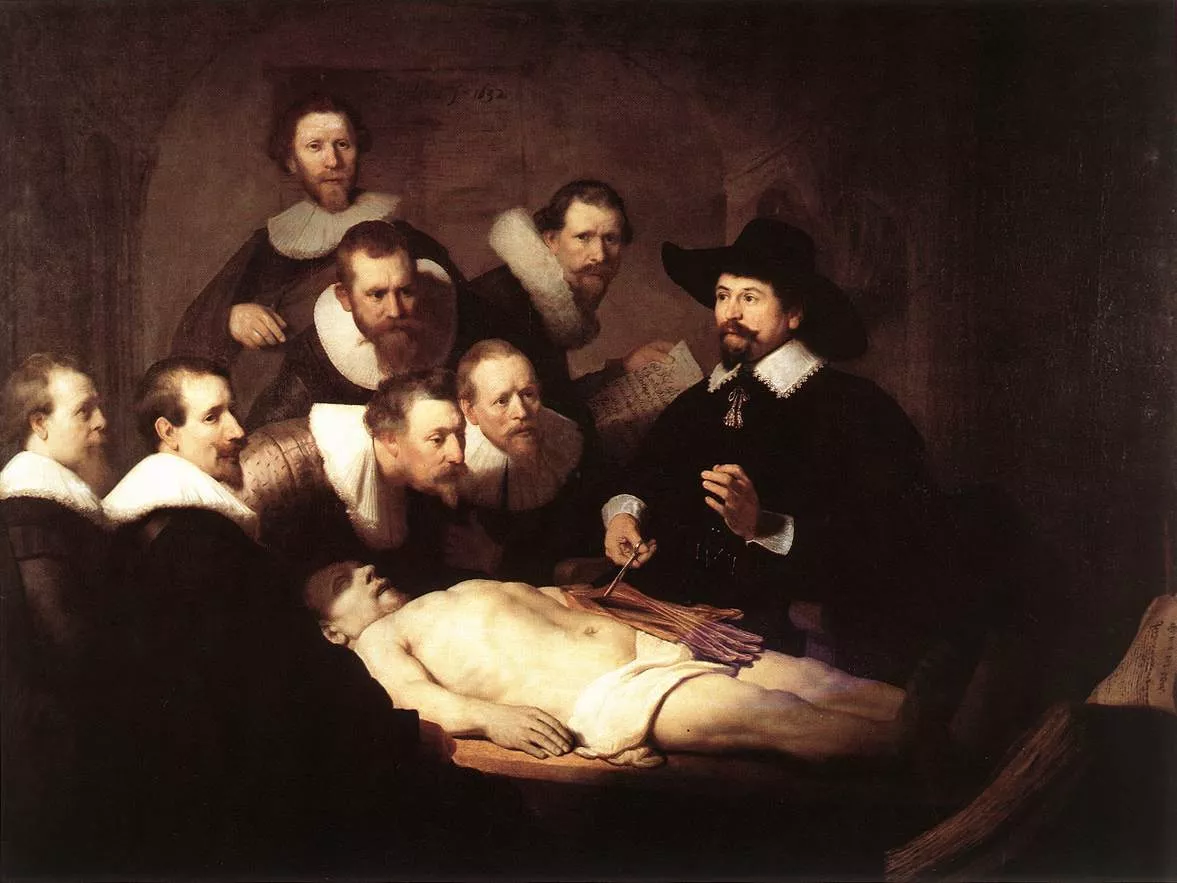 Alt.name: The Anatomy Lesson of Dr. Nicolaes Tulp is a 1632 oil painting on canvas by Rembrandt housed in the Mauritshuis museum in The Hague, the Netherlands. It was originally created to be displayed by the Surgeons Guild in their meeting room.
Even the darkest backgrounds in his portraits aren't uniform. Look closely and you'll see subtle variations: deep browns, muted blues, hints of green. Each nuance adds depth, making the light feel earned rather than artificial.
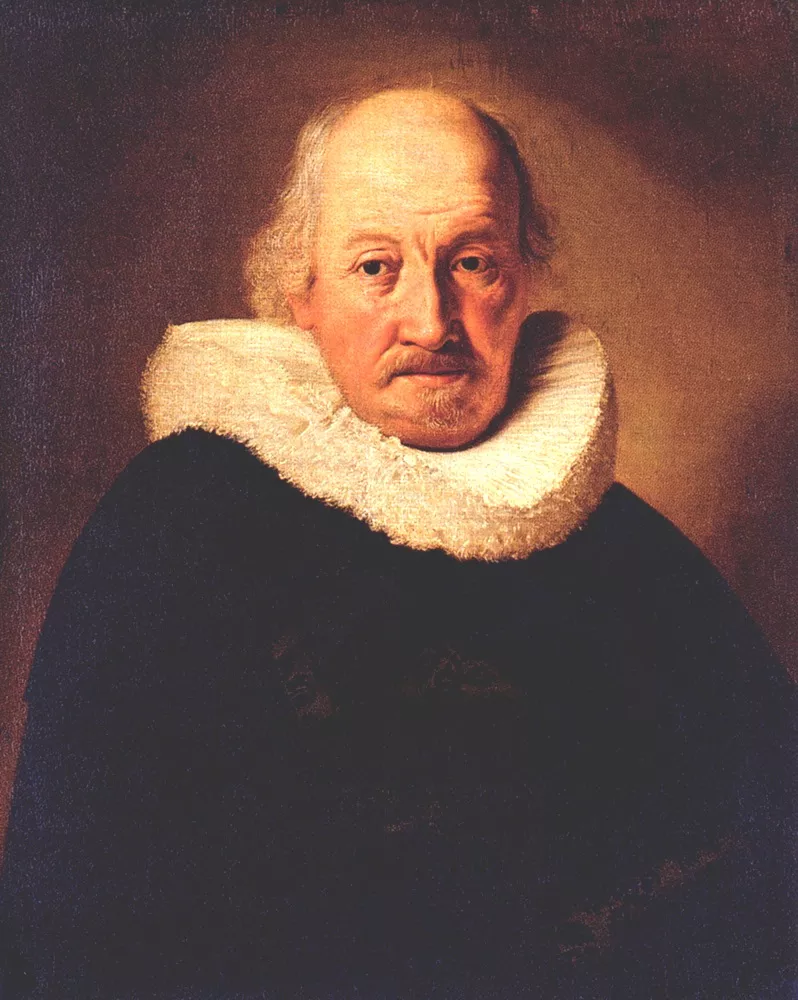
And the light itself is never static. In portraits like Jan Six or Portrait of an Old Man, it strikes from unconventional angles, highlighting subtle expressions, creases, and gestures. It guides the viewer's gaze while creating psychological tension. Each brushstroke of light and dark conveys presence, character, and the passage of time.
This careful, layered approach is why Rembrandt's chiaroscuro feels emotional rather than purely decorative. It's a conversation - light speaks, shadows whisper. It's this dialogue that continues to make his Baroque painting style a masterclass centuries later.
Impasto in The Jewish Bride
In The Jewish Bride, Rembrandt’s use of impasto is subtle but alive. The paint isn’t flat, it rises from the canvas in gentle ridges, especially on the fabrics, the embroidered details, the folds of the golden gown. Look closely at the wife’s sleeve or the intricate patterns of her dress — the brush has left traces, little peaks of paint that catch the light differently as you move.
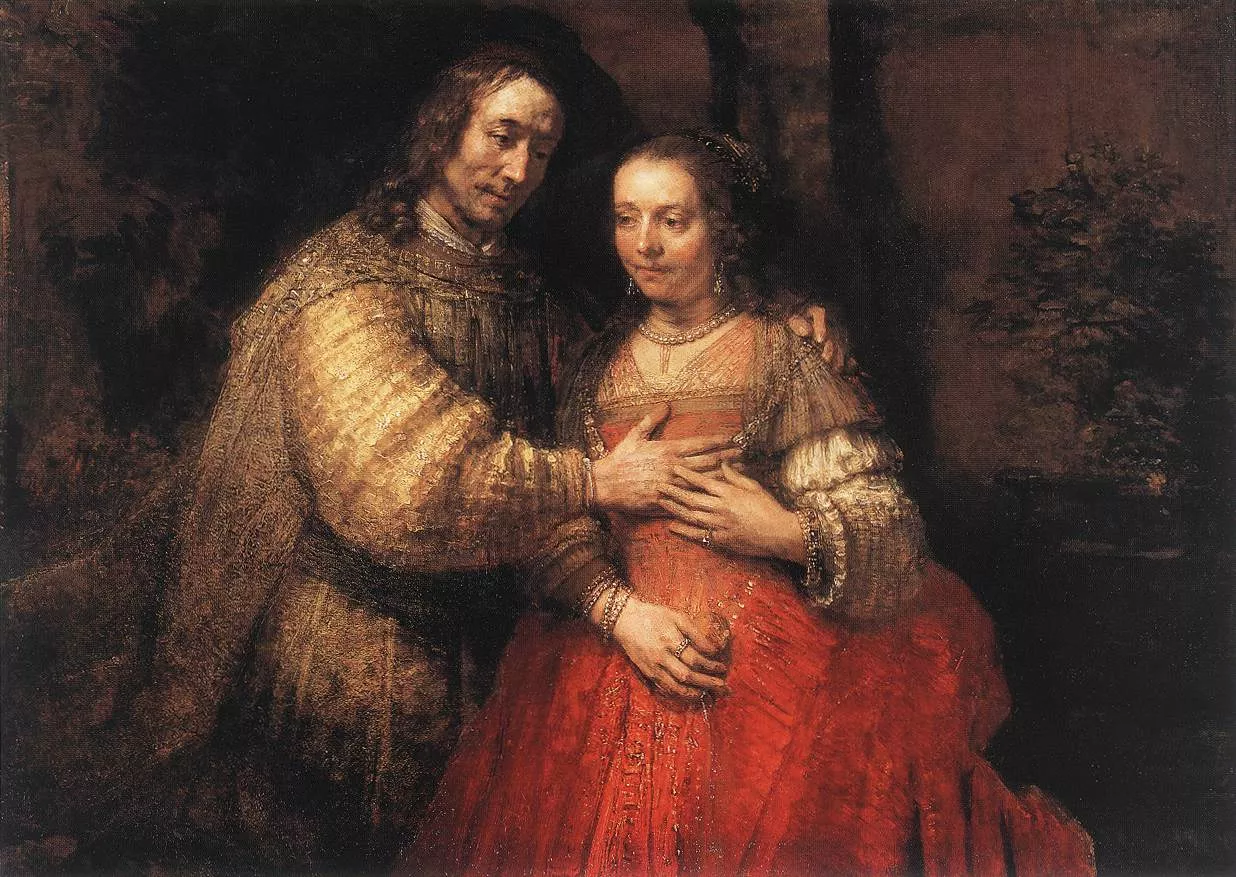 The Jewish Bride is a painting by Rembrandt, painted around 1665‒1669. The painting gained its current name in the early 19th century, when an Amsterdam art collector identified the subject as that of a Jewish father bestowing a necklace upon his daughter on her wedding day.
This isn’t decoration. Impasto here gives weight, presence. The figures seem tactile, almost touchable. You feel the heft of her shoulder, the warmth of their hands meeting. The thick strokes aren’t uniform, some are quick, rough, others smoothed into the softer glow of skin. It mirrors the intimacy of the scene — the way he paints love is through texture as much as color.
Even the background has traces of impasto — subtle ridges that suggest space without hard lines. Shadows and highlights interact with the thickness of the paint, enhancing the volume, giving the figures a three-dimensional presence. The technique lets the light play across the surface, almost like the canvas is breathing.
In The Jewish Bride, impasto becomes a way to feel the moment. You don’t just see the couple, you sense the connection, the warmth, the human pulse behind the pigment. Rembrandt’s mastery isn’t just in the image, but in how the paint itself carries emotion.
Brushwork That Breathes
Rembrandt’s brushwork is the pulse of his paintings. Baroque peers often polished surfaces, but he left life in the strokes. Thick in some areas, thin in others, scraped, reworked — every gesture counts.
In Portrait of an Old Man, you can see the texture of skin, the weight of a cloak, strands of hair. In historical scenes, brushwork becomes smoke, dust, firelight. It’s not mechanical — it’s alive, responsive. Watching it, even in reproduction, feels like seeing him think with his hands.
Students flocked to his studio to learn gestures, layering, mixing. The brush records decision-making, observation, hesitation. That’s why his work feels intimate, human — even in commissioned portraits designed for display.
Composition That Speaks
Rembrandt’s compositions are storytelling devices. Objects, figures, empty spaces — everything matters. In The Anatomy Lesson, the central cadaver draws attention, but hands, faces, floorboards catching light, gestures — all guide the viewer through the narrative. Composition isn’t decoration, it’s psychological and spatial guidance.
Even small portraits rely on careful placement. Tilt of a head, angle of a hand, subtle shadows — they dictate rhythm, pause, and focus. The viewer experiences the person more than the painting. That’s Baroque mastery made intimate.
Layering Emotion With Color
Baroque often meant dramatic reds, golds, and strong contrasts. Rembrandt chose restraint. Brown isn’t just brown — it’s warmth, weight, humility. Dark backgrounds aren’t voids — they’re tension, anticipation, narrative.
He layered pigments slowly, letting them interact, reworking until they felt alive. Jan Six shows this: subtle ochres and grays in shadows, reflected light on sleeves, highlights barely brushed in. Color conveys emotion, presence, narrative.
Human Touch in Historical Scenes
Grand themes — biblical, civic, mythological — become human in his hands. Look at The Night Watch or a guild portrait. Pride, doubt, uncertainty. Faces speak of inner lives, not just social rank.
Brushwork amplifies psychology: curve of a lip, tilt of an eye, tension in hands. Each decision amplifies the story, giving ordinary gestures weight and significance.
Why Study Rembrandt Today?
Artists, photographers, filmmakers — all study him. Why? Light and shadow as narrative. Composition as storytelling. Brushwork as presence.
Baroque painting techniques explained through his work aren’t formulas. They’re invitations. Slow down. Observe. Notice weight. Watch emotion emerge. It’s messy, sometimes confusing. That’s what makes it alive.
Seeing Beyond the Canvas
Anyone who has stood before a small Rembrandt portrait — barely the size of a laptop — knows the feeling. The presence is enormous. There’s air around the figure, a quiet pulse that seems to come from the paint itself. It isn’t decoration, it’s a dialogue. Every layer of light and shadow, every brushstroke, feels like a lesson in how to see — and how to look longer than comfort allows.