
Who was Agatha Bas?
Agatha Bas (1611–1658) wasn’t a random sitter. She was the daughter of Dirck Jacobsz Bas, director of the Dutch East India Company and member of Amsterdam’s city council. In 1638 she married Nicolaes van Bambeek (1596–1661), a prosperous Flemish cloth merchant. Rembrandt painted both: Agatha in 1641, Nicolaes soon after. The two portraits were conceived as companions — a matched pair that would hang side by side, their gazes balanced across the room. Today they live apart: Agatha in London’s Royal Collection (RCIN 405352), Nicolaes in Brussels.
Rembrandt, by then, was already established in Amsterdam. These weren’t just commissions; they were collaborations between artist and elite patrons, each aware of the other’s social and creative capital.
First impressions — the gaze and the frame
She looks straight at you. Not demurely, not with that gentle evasion typical of 17th-century women’s portraits. Directly. There’s something unsettling about it.
Her upper body fills the frame — black silk dress, white lace collar, gold-threaded bodice — against a dark, almost green-black background. But what’s truly clever is the illusion of the painted frame within the painting itself. Her left hand rests on its edge. Only, that edge isn’t real. It’s painted. Which means her hand appears to reach beyond the picture plane.
Rembrandt, the magician, dissolves the barrier between art and reality. You start to wonder: who’s inside the frame, and who isn’t?
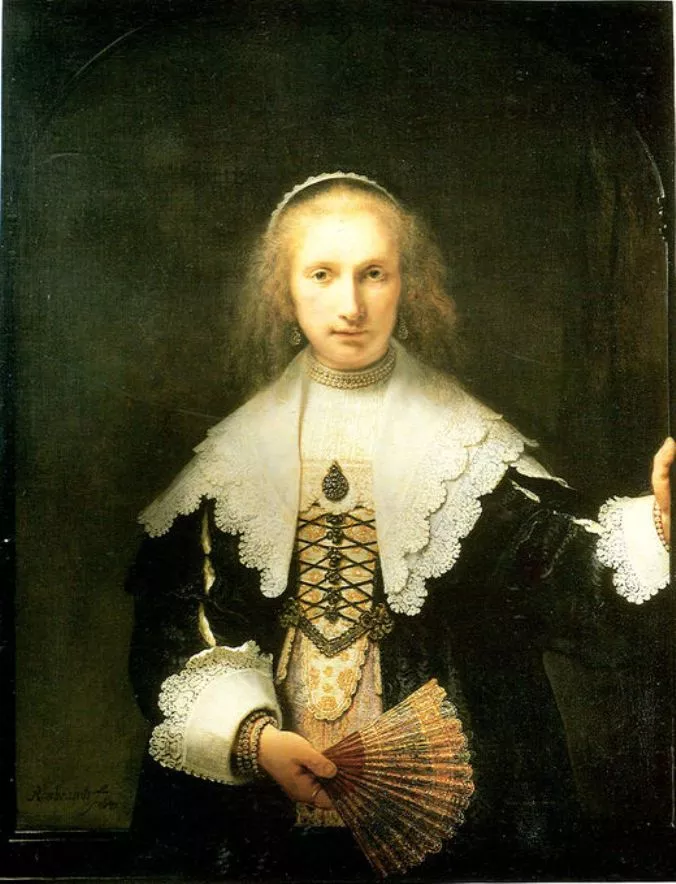 Agatha Bas portrayed by Rembrandt van Rijn in 1641, half-length figure with fan and dark background.
The craft behind the illusion
Rembrandt at his technical peak. You can almost feel the confidence in every stroke.- Impasto and texture
The lace cuffs, pearls, fan ribs — they shimmer because of real paint relief. He used impasto, letting the paint stand thick on the surface so that light hits it physically. Those highlights on the pearls? They’re tiny, solid mounds of lead white, not flat pigment. - Layers and glazes
Her skin — soft, luminous, alive — comes from layer upon layer of translucent glazes. A warm underpainting, a cool glaze, then a final veil of tone. It’s like breathing through light. - Light and shadow
The famous Rembrandt chiaroscuro is in full play: face and chest illuminated, everything else swallowed by darkness. Look at her eyes — one slightly brighter than the other — it’s that imbalance that gives her presence, as though she’s breathing. - Trompe-l’oeil
That hand over the frame is the boldest trick. It’s not just illusion for illusion’s sake. It’s a philosophical gesture: if the hand can cross into our world, maybe so can she. - The luxury of detail
The lace, the gold embroidery, the faint sheen on the black silk — every detail whispers of wealth. Yet Rembrandt paints them not as trophies, but as tests of perception. You can see where the brush thins, where pigment meets linen grain. It’s all deliberate.
This isn’t just a portrait
It’s a performance. A conversation.
Agatha doesn’t simply pose; she occupies space. She’s aware of us. Her hand on that imaginary ledge blurs the boundary — it’s as if she’s caught mid-gesture, acknowledging our gaze. In 1641, that was radical. Most portraits of women were polite, contained, introspective. Agatha’s isn’t. It’s assertive.
The painting turns into a mirror — not reflecting us, but questioning us. Who’s observing whom? And which of us feels more real in that exchange?
The 1640s — a turning point
By 1641, Rembrandt was the undisputed star of Amsterdam’s art world. He had mastered everything: texture, perspective, human psychology. Now he was experimenting with how painting itself could interact with reality.
The idea of the sitter “breaking the frame” was revolutionary. In a way, he was predicting what photography and cinema would later do — collapsing the distance between viewer and subject.
And in this period, just before personal tragedy and financial trouble reshaped his style, Rembrandt’s technique reached almost impossible refinement. You sense that he knew it too. This painting feels like a peak — and a threshold.
Looking closer
Stand close to the painting and it becomes almost abstract.
The lace is a web of paint, gray over white, white over shadow. The cheek’s blush is a mix of red lake and yellow ochre, so thin you could miss it. The fan — strokes quick and confident — moves between description and suggestion. The background isn’t black but a storm of greens and browns; it breathes.
And the hand — the famous hand — just touches that inner frame, where shadow turns to illusion. It’s enough to make you reach out, reflexively, before you stop yourself.
Then and now
For the Bambeek family, this portrait was status. For us, it’s intimacy. We see time condensed — the silk, the lace, the glow of human skin, all still present. It’s not a photograph, yet somehow it feels more real than one.
Maybe that’s the paradox, the more paint pretends to be flesh, the more we’re reminded it isn’t. We see the trick and still believe it. That’s Rembrandt’s genius — he makes illusion feel honest.
How to look
Try this if you ever stand before it:
- Step close. Watch the lace — see how the paint rises, heavy and deliberate.
- Step back. Notice how the figure blooms from the dark.
- Find the fan. It guides your eye up to her hand, to her face, to the eyes.
- Look at her left hand — the one on the ledge. Ask yourself if you believe it’s real.
- Then ask: who’s watching whom?
That’s the test. Rembrandt’s portraits are as much about you as about them.
Why it matters
Art historians often say that by the early 1640s, Rembrandt had reached a point where perfection was almost beside the point. His portraits became explorations of presence, of how far painting could go before collapsing into life. Agatha Bas is that moment made visible — poised between mastery and mystery.
He would go on to break his own rules, to paint rougher, freer, more spiritual works. But here, everything still holds together. Control, light, flesh, illusion — balanced on the edge of belief.
A final thought
When you look at this portrait, you don’t just see a woman from the Dutch Golden Age. You see an artist daring to ask what a painting can be. You see a subject aware of her own power.
And for a few seconds, standing there, you almost believe she’s about to move — that the silk will rustle, the pearls will shift, the eyes will blink.
Then you remember it’s only paint.
Only light.
Only Rembrandt.
Watch & Listen — Agatha Bas and the Language of Light
Sometimes words can’t quite describe what Rembrandt does with paint. Below are two short films exploring the portrait of Agatha Bas — her quiet presence, the illusion of depth, and the artist’s technical daring.
Desmond Shawe-Taylor on Agatha Bas
Surveyor of The Queen’s Pictures, Desmond Shawe-Taylor, offers a clear and elegant breakdown of Rembrandt’s technique — how light, texture, and gesture combine to make Agatha seem almost alive.
Agatha Bas in British Sign Language
This video presents the story of Rembrandt’s portrait through British Sign Language, making one of the Dutch Golden Age’s masterpieces accessible to a wider audience.